


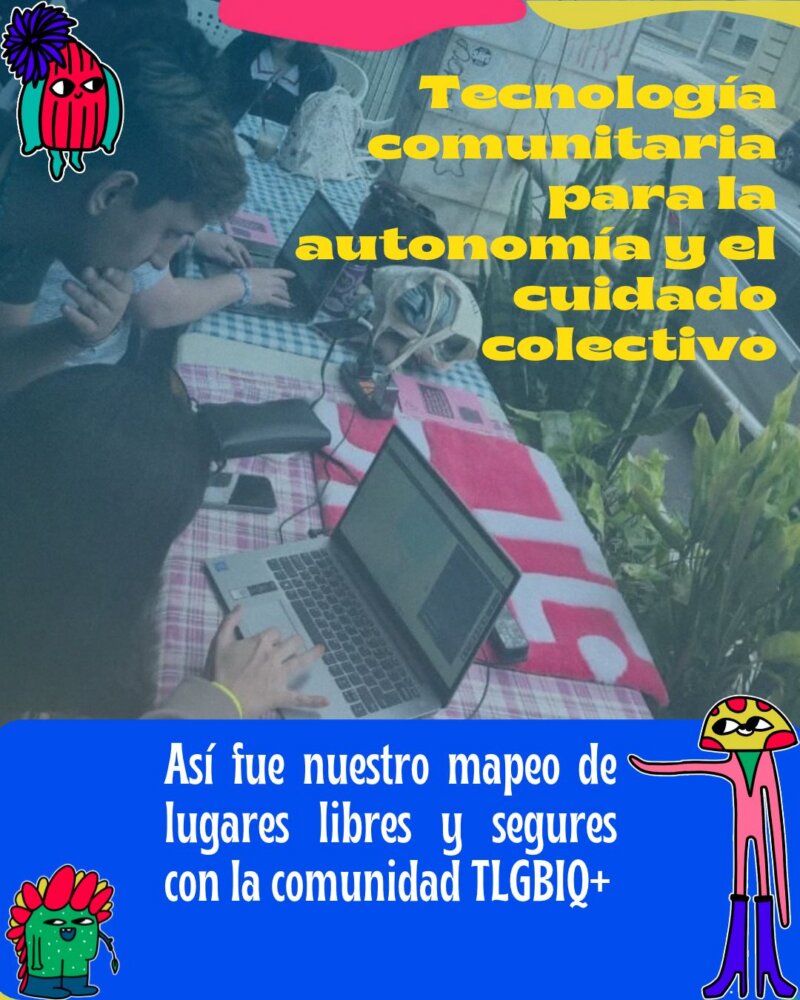
A collaborative workshop on safe and free spaces for the TLGBIQ+ community
At TEDIC, we understand that the ongoing commitment to the intersection of technology, digital rights, and a feminist and diversity-focused approach is crucial for society. We constantly ask ourselves how digital tools, far from being neutral or detached from our daily lives, can become concrete instruments of collective care, spatial appropriation, and resistance for communities that are currently excluded.
Last Saturday, September 12th, we held the “Free and Safe Mapping Workshop”. This time, we decided to decentralize the usual training spaces and met at Café Consulado in Asunción. The choice of location wasn’t random: we wanted to inhabit an everyday, friendly, and relaxed environment that broke away from traditional classroom dynamics, fostering truly horizontal, close, and participatory dialogue.
Mapping from lived experience: conversation as the starting point
Unlike conventional technical training, the session didn’t start in front of a screen. Around a shared table, with coffee and a relaxed vibe, we gathered TLGBIQ+ community members to open a space for collective reflection before diving into digital cartography.
The afternoon kicked off with a simple but deep question: What does it really mean to feel free and safe in a space? Through fluid discussion, participants shared their everyday experiences navigating the city, identifying nuances, codes, and feelings that shape their ability to stay and move through different places. We debated why diverse spaces tend to cluster in downtown Asunción and found other spots beyond the central core of the capital.
From this collective exchange, a key insight emerged for the project: the difference between being labeled “TLGBIQ+ friendly” and actually being a safe space. On one hand, spaces that openly proclaim themselves “friendly” are places that use labels or public stances to show openness to diversity—whether or not they’re directly focused on the community, they fully embrace it.
On the other hand, safe spaces from lived experience are establishments that don’t explicitly market themselves as “friendly” or fly visible flags, but in daily practice have proven to be truly welcoming. They respect gender identity and expression, allowing the community to occupy the space with full peace of mind and without fear.
This distinction helped us establish much finer analytical criteria for categorizing places on the map, based on the lived experiences shared by the community—not just labels or business advertising.
Community tech with uMap and OpenStreetMap
Once we agreed on the categorization criteria based on lived experience, we moved into building the interactive map. To ensure sustainability and open access to the data, we used uMap, a free web tool built on OpenStreetMap’s collaborative mapping layers.
We chose this platform because it democratizes tech access—no advanced programming or GIS skills are needed, so anyone can take ownership of the mapping process. Plus, all the data generated can easily be extracted and added to the public geodata base.
During the hands-on part of the workshop, we guided participants through the core aspects of the tool:
- Precise location and georeferencing of points on the map
- Thematic categorization of establishments (food, culture, services, etc.)
- Writing and adding qualitative descriptions based on the group’s stories.
Thanks to active participation and teamwork, by the end of the day we’d identified and logged over 70 spots where people reported experiences of openness, acceptance, and respect. Beyond the number of entries, the real value of the workshop was the transfer of tech skills. Learning to use these free tools together ensures the community isn’t dependent on intermediaries and can keep updating, auditing, and enriching this mapping network on their own over time.
Community tech for urban autonomy and care
Maps aren’t neutral—they determine which realities get visibility, whose stories are told, and how the right to the city is shaped. For TLGBIQ+ folks, having verified references built collaboratively about where they can express themselves safely is a strategic tool for autonomy, mutual care, and well-being.
The collaborative mapping workshop proves that when tech serves communities and combines participatory methods in everyday meeting spaces, it becomes a driver for social change. These are spaces for the community that help build a more diverse, free, and safe Paraguay for everyone.
 It’s time for a law on digital violence against women in Paraguay