


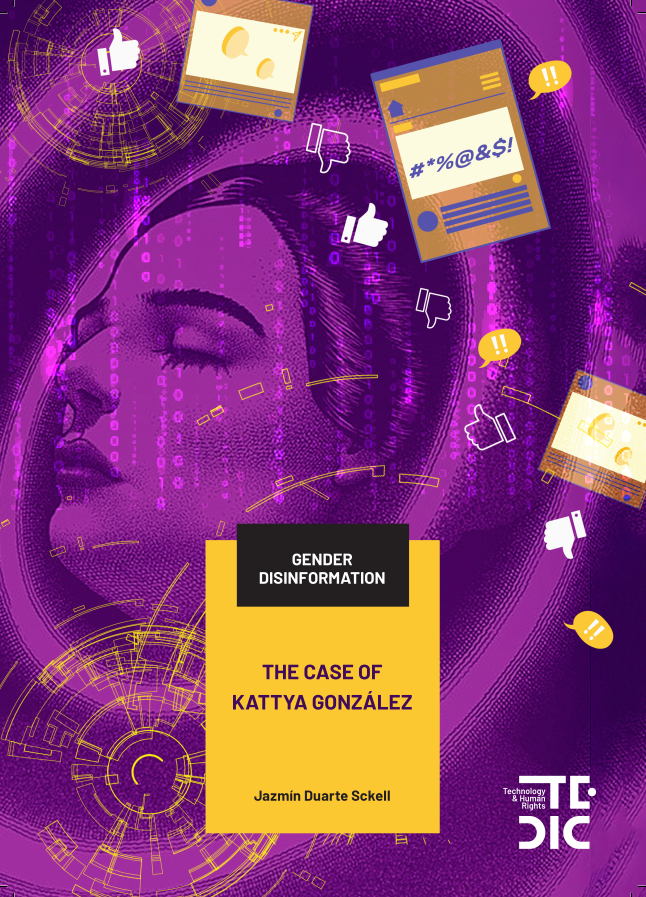
TEDIC presents new research on disinformation and gender in Paraguay
Kattya González was the fourth most-voted senator in the country and the candidate with the most support from the opposition. A year after taking her seat, she was removed from office by the vote of 23 of her colleagues, in an extraordinary session called during a full parliamentary recess. In between, something happened that often goes unnoticed in political analysis: a sustained campaign of disinformation and digital hatred that paved the way for her removal.
That’s the question guiding our new research, “Gender Disinformation: The Kattya González Case,” which we’re publishing today at TEDIC: what happens when political violence against women moves into, and is amplified by, the digital environment?
A Violence That Isn’t New, But Is Now Amplified
Political violence against women didn’t start with the internet. It’s a historic strategy for keeping power in male hands by limiting women’s participation in public life. What’s changed today is the scale and speed: misogynistic messages, coordinated campaigns, and false content that can go viral within hours and reach millions of people.
We call this Technology-Facilitated Gender-Based Violence (TFGBV): any act that, through digital tools, causes physical, psychological, social, political, or economic harm to a woman, or violates her rights and freedoms. When the target is a woman with political power, the goal is almost always the same: wear her down until she’s pushed out of the picture.
Since 2016, we’ve been documenting how this type of violence takes shape on our website: Digital violence is real.
The Kattya González Case, Step by Step
Our researchers Jazmín Duarte Sckell and Mariela Cuevas reconstructed the case based on press coverage, prior research, and a direct interview with the former senator, showing that what happened to her was not an isolated event, but rather a process rooted in a conservative system that doesn’t allow women to participate in political life.
Our researchers document how, during her time as a deputy between 2018 and 2023, Kattya navigated that hostile space, facing constant scrutiny from the press and intimidation that extended even to her family. During the 2023 electoral campaign, she was one of the most attacked female candidates on social media, with messages about her physical appearance and out-of-context edited images. And once in the Senate, the campaign that would end in her expulsion combined disinformation, doxxing, and death threats, following an identifiable pattern: anonymous profiles and trolls launched the first messages and hashtags #FueraKattya (“OutWithKattya”), media outlets aligned with the ruling party amplified them as confirmed information, and lawmakers used them as grounds to call for her removal.
Her staffer Soledad Blanco was also a direct target, subjected to the spread of edited, sexualized intimate images.
On February 14, 2024, with barely two hours between the filing of the accusatory motion and the vote, 23 senators decided to strip her of her seat.
What the Supreme Court Itself Said
In June 2026, after two years of waiting, the Supreme Court of Justice upheld the legality of the procedure that removed her. But in its own ruling, it acknowledged something significant:
“The exclusion of Ms. Kattya Mabel González Villanueva contains features that could be categorized as political violence on account of her status as a woman […] This demonstrates the persistence of stereotypes or biases linked to women that perpetuate inequality and discrimination.”
This is a meaningful signal: even the country’s highest court identified the gender component in a case that, until then, had been debated solely in terms of parliamentary legality.
Why This Matters to All of Us
The cost of these kinds of campaigns isn’t only individual. When a woman backed by the electorate is removed this way, the message sent to everyone else is clear: occupying positions of power comes at a very high price. The consequence, documented time and again, is that women end up lowering their public exposure, self-censoring, or leaving political life altogether.
That erodes something bigger than one individual’s career: it erodes the quality of democratic representation in Paraguay, where women hold just 23% of seats in Congress, well below the regional average.
The Case Remains Open
Kattya González did not stay silent. Together with CODEHUPY, she took her case to the United Nations Human Rights Committee, challenging the violation of due process and the closing of civic space in Paraguay. This litigation, beyond her personal situation, seeks to establish clear standards on the limits of political power and guarantees of the right to representation.
At TEDIC, we document this case because we believe that naming these patterns is the first step toward confronting them. And because, as our research points out, Paraguay still doesn’t have a specific law against technology-facilitated gender-based violence, despite the fact that a regional framework already exists: the Inter-American Model Law from MESECVI (2025), which could guide that progress.
 Not with my face: The Paraguayan State deploys facial recognition without transparency or oversight