


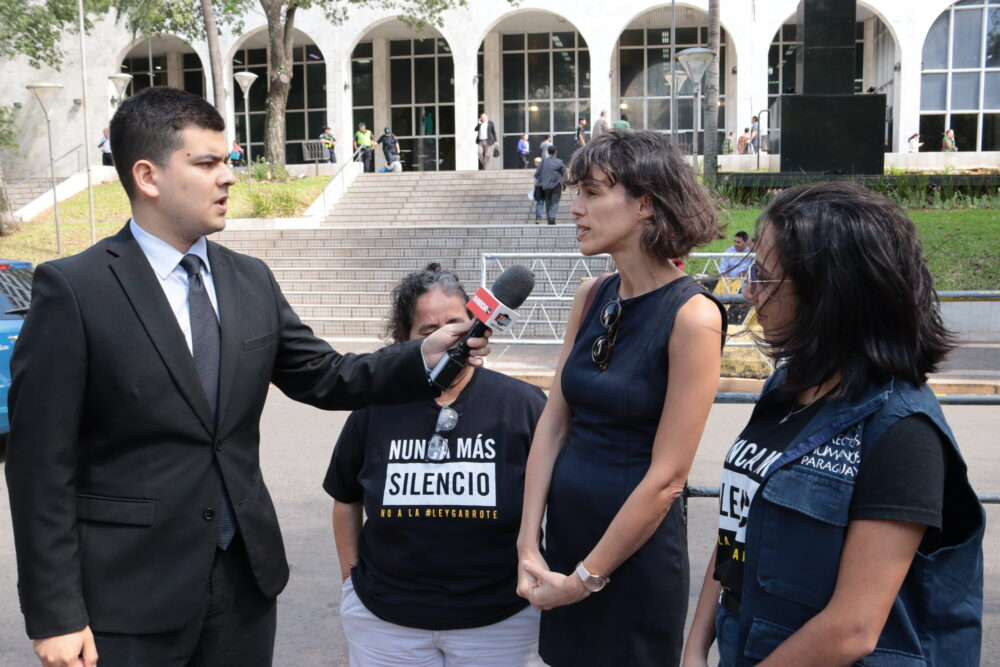
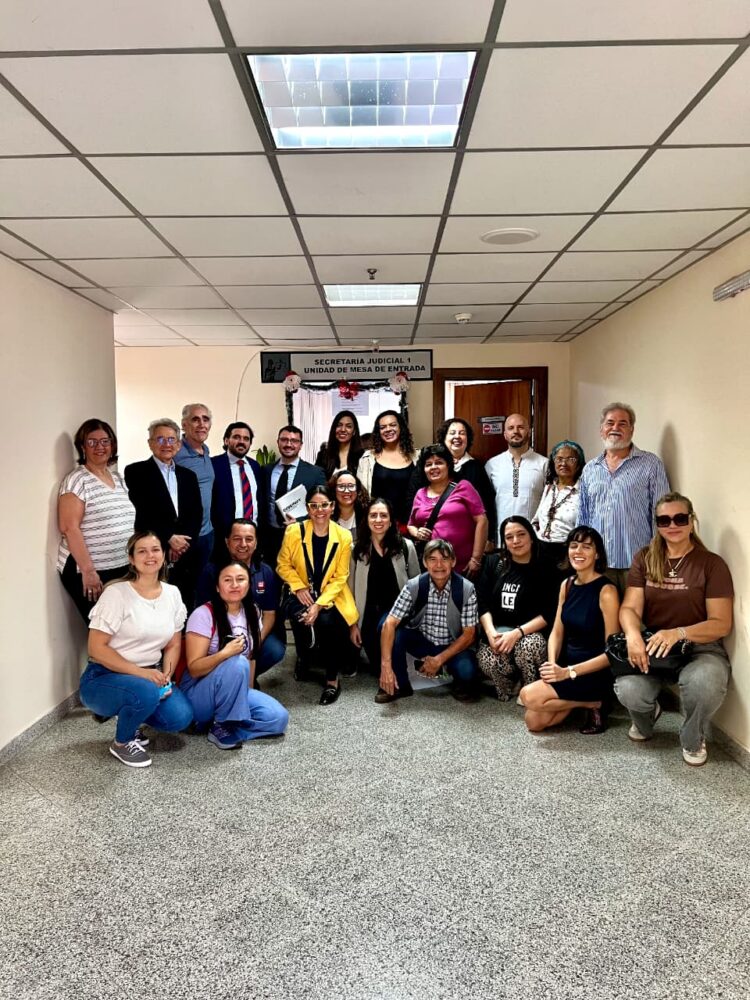
From TEDIC, and as an organization that is part of the Human Rights Coordinator of Paraguay (Codehupy), we joined multiple social organizations in the formal filing of an Action of Unconstitutionality against Law No. 7363, known as the “Gag Law”, on the grounds that this legislation violates fundamental rights guaranteed by the National Constitution and weakens democratic space in Paraguay.
The action was formally submitted on Tuesday, December 16, at 10:30 a.m., at the Palace of Justice.
The Gag Law establishes excessive, discretionary, and punitive control over non-profit organizations, directly affecting the constitutional rights to freedom of association and political participation. From a constitutional and human rights perspective, the organizations argued that the regulation violates essential principles such as freedom of association (Art. 42), freedom of expression and participation (Arts. 26 and 40), the principle of legality (Art. 9), as well as Paraguay’s international obligations regarding the protection of civic space.
We also emphasized that this action responds to the need to safeguard community-based work that supports thousands of people in situations of vulnerability. By introducing suspicion and the possibility of arbitrary sanctions, the regulation creates a climate of fear and uncertainty that directly affects solidarity initiatives, as well as educational, cultural, agricultural, and social support projects throughout the country. As we stated, “what is at stake is not an administrative procedure, but the freedom of communities to organize and support one another without fear.”
The event included the participation of legal representatives who explained the core arguments of the action, as well as community leaders who provided firsthand testimony on how this regulation threatens the social work that sustains thousands of families across the country.
We thank journalists, media outlets, social organizations, and the general public who accompanied this filing, recognizing that defending freedom of association is, ultimately, defending democracy itself.
Summary – Main Concerns Regarding the Law
The law introduces a regulatory and oversight regime for non-profit organizations (NPOs) that raises serious concerns in five main areas:
- Mandatory Registration (Article 7):
A new registration requirement is imposed before the National Directorate of Tax Revenues (DNIT), including for international organizations operating directly or indirectly in the country. Local organizations are made responsible for any failure of their international partners to register. This increases bureaucracy, discourages international cooperation, and assigns responsibilities that exceed the legal authority of local NPOs. - Oversight of Private Funds (Article 3):
The law requires accountability for private funds, whether domestic or international, even though these resources derive from private contracts or individual donations. This expands state control beyond reasonable limits. - International Transfers and the General State Budget (Article 12):
The wording is unclear as to whether international transfers that support public policies must pass through the General State Budget, potentially hindering international cooperation if the requirement is not limited strictly to public funds transferred to NPOs for execution. - Broad Information Requests (Articles 9 and 11):
The law allows authorities to demand extensive and detailed information — including data on beneficiaries, contracts, and personnel — without requiring a judicial or administrative process. This may violate constitutional rights such as privacy, the right to work, and the inviolability of documentary records (Article 36 of the National Constitution).
Both the Inter-American Commission on Human Rights (IACHR) and the UN Special Rapporteur have warned that oversight mechanisms must not be disproportionate, overly bureaucratic, or used to obstruct or silence the legitimate work of associations. - Sanctions System (Articles 13–18):
Although confiscatory fines were removed, the law still allows for double sanctions — against both the organization and its individual members. Sanctions include suspension of activities for up to six months and disqualification of board members or directors for up to five years in cases of repeated offenses.
 WICE – WOMEN’S IN CYBERSECURITY EMPOWERMENT
  [Research] Technology-facilitated gender-based violence against women politicians in Paraguay