


By: Araceli Ramírez
Abstract
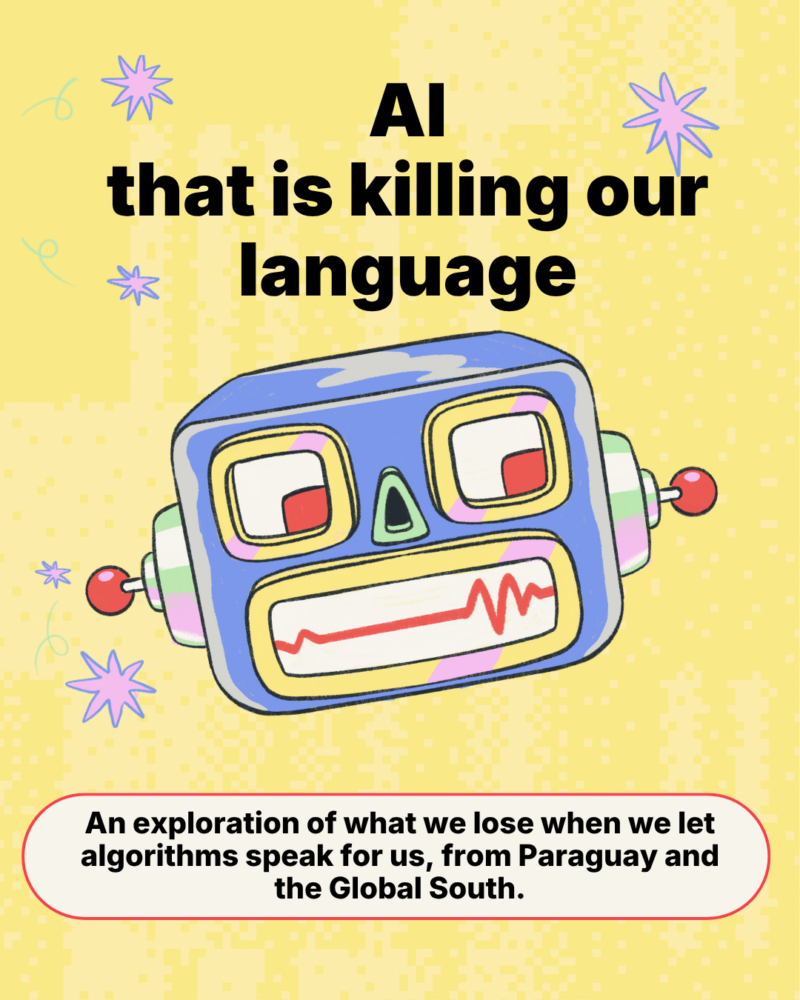
Generative AI is no longer “just another tool”: it is increasingly becoming a cultural infrastructure for the production of language. It can generate coherent and functional discourse, yes, but in doing so it displaces central elements of the social life of language: conflict, opacity, territory, the body, and historicity. In dialogue with Éric Sadin, this article proposes the term necro-logos to describe this “dead language”: a spectral linguistic economy whose guiding principle is optimization (fluency, acceptability, compatibility with dominant norms) and whose cultural effect is to foreclose the unexpected (Sadin, 2024; Sadin, 2020).
As a counterpoint, I propose bio-poiesis: situated, embodied, and relational creation, which feminisms and Southern epistemologies uphold as a political practice of resistance and world-making (D’Ignazio & Klein, 2020; Ricaurte, 2019). Focusing on Paraguay and Latin America, I argue that generative AI intensifies a double colonization: that of data (epistemic extractivism) and that of imagination (cultural homogenization), with glottopolitical effects on local languages and registers, and differentiated impacts shaped by gender and structural inequality (Ricaurte, 2019). Drawing on regional intervention initiatives (such as EDIA/Vía Libre and Latam-GPT), I conclude by proposing lines of action grounded in digital rights: feminist data governance, situated bias auditing, critical literacy, and technology design oriented toward care (Costanza-Chock, 2020; D’Ignazio & Klein, 2020).
Keywords: generative AI; language; algorithmic glottopolitics; data feminism; Global South; digital rights; creativity; data sovereignty.
When Prediction Becomes Culture
There is a scene that repeats itself, with only minor variations, in offices, classrooms, and newsrooms across the region. Someone opens a chat window, types two lines (“write me a formal statement,” “draft an executive summary,” “put together a press text”), and receives a polished, courteous, almost impeccable result. The feeling is ambivalent: relief at the speed and, at the same time, a difficult-to-name unease. Not because the text is bad, but because the text sounds as if it came from nowhere. It is language without temperature, without friction, without traces. A “correct” language that seems to float.
That floating quality is not merely an aesthetic detail. At the heart of generative AI lies an operation that has become so ordinary it is nearly invisible: turning language into a problem of prediction. Where language was once an event (saying something at a particular moment, with a body, with risk), it is now administered as probability: which word follows which, which phrase “works,” which tone “fits,” which form minimizes conflict and maximizes acceptability. The result is a kind of airport prose: useful, universal, without territory.
Éric Sadin has described this shift as part of a broader mutation: the transition toward an algorithmic administration of existence, in which life itself is organized through technical layers that do not merely assist, but decide, orient, and normalize (Sadin, 2020, 2023). In this reading, generative AI is not a friendly piece of software: it is a cultural technology that reconfigures language as a manageable resource. And if language becomes manageable, then creativity does too; and if creativity becomes manageable, culture enters a new regime of governance.
This article begins from a strong hypothesis: generative AI is producing an epochal shift in the cultural ecology of language. Not only through the automation of texts, but because it installs prediction as a criterion of expressive legitimacy. What is written (and how it is written) increasingly comes to be evaluated, suggested, corrected, or rewritten by machines trained on vast datasets. In this way, the statistical average of the past is transformed into the norm of the present.
From Paraguay and the Global South, this transformation does not arrive on neutral ground. It arrives in societies marked by structural inequalities, colonial histories, linguistic tensions, and feminist and dissident struggles that have made language itself a practice of rupture. For this reason, rather than asking whether AI “is creative,” the more important question is: what kind of creativity becomes dominant when language becomes prediction? What happens to situated narratives—those emerging from the margins, from counter-hegemonic spaces, from social conflict—when the cultural standard is defined through optimization?
To name this regime, I propose necro-logos: a dead language in the political sense of the term. Not because it fails to produce sentences, but because it reduces language to performance: fluency, coherence, plausibility, usefulness. Against this, I propose bio-poiesis: living creation as a situated, feminist, and decolonial practice aimed at sustaining the power of the unexpected.
A situated philosophical critique
In this article, I adopt a critical theory of technology approach grounded in digital rights and cultural studies of language. Methodologically, I combine:
1. Conceptual analysis (necro-logos, bio-poiesis, algorithmic glottopolitics), in central dialogue with Sadin and with feminist and decolonial contributions (Haraway, 1988; D’Ignazio & Klein, 2020; Ricaurte, 2019; Costanza-Chock, 2020).
2. A cultural sociology reading of generative AI as an infrastructure for symbolic production, paying attention to the political economy of data and platforms (Zuboff, 2019; Crawford, 2021).
3. Regional case studies as intervention practices: EDIA (Vía Libre) and Latam-GPT, understood not as “technical solutions” but as disputes over data governance, language, and technological sovereignty.
My objective is not to offer a “technical evaluation” of these language models, but to contest the cultural and political meaning of generative AI from the Global South.
Spectral life: the mutation of language into a commodity
Sadin describes a present in which the digital ceases to be an external tool and instead operates as a layer that reorganizes experience: a “spectral life” in which technical mediation produces a world of disembodied presences, decisions without deliberation, and actions without a fully accountable subject (Sadin, 2023). The spectral does not mean “false,” but disembodied: a form of presence that operates without the weight of the body, time, and conflict.
Generative AI intensifies this spectrality because it touches the raw material of cultural life: language. If language is the place where a community argues, imagines, fights, agrees, remembers, and projects itself, then turning it into an optimized output is not a minor shift. It is a reconfiguration of culture.
In the philosophical tradition, language is not merely a vehicle. It is a site of struggle over meaning. By contrast, the generative model operates as a machine of stabilization: it produces “correct,” predictable phrases, in a register that tends toward conciliation and neutrality. In this gesture, there is a politics of language: less conflict, less singularity, more compatibility.
Here emerges the first thesis of the article:
Thesis 1. Generative AI introduces a cultural economy of the word based on optimization, in which the criterion of “good language” shifts toward fluency and acceptability, deactivating the conflictual and situated dimension of meaning (Sadin, 2023).
This does not mean that all generated text is “bad.” It means that the cultural regime being installed privileges a certain kind of language: language that does not unsettle.
Necro-logos: dead language as a regime of prediction
To say that language models “predict the next word” often sounds like a popularized technical explanation, as if it were merely a mechanical detail. But within the framework of this article, that minimal operation—prediction—is not a neutral mechanism: it is a cultural ontology. Generative AI does not “participate” in language as an event; it treats it as a probabilistic space in which continuity matters more than rupture. And that priority is not only computational: it becomes a normative principle when these systems turn into everyday writing infrastructure in schools, media, companies, civil society organizations, and the state.
A language model is trained on large textual corpora produced under specific historical conditions: press archives, digitized books, forums, social media, websites, manuals, bureaucratic documents, etc. In that training process, language is reduced to a structure of statistical regularities: the model learns which sequences are frequent, which associations recur, which turns of phrase are “expected.” The decisive point is that what we call the system’s “output” is the selection—under different sampling and tuning techniques—of what is most probable (or sufficiently probable) within that space (Bender et al., 2021). It does not produce what a subject “means to say”; it produces what fits.
From this perspective, the model is extraordinary at tasks that depend on continuity: summarizing, rewriting, standardizing, completing, homogenizing. But there, too, the core of its conservatism is revealed: its creativity is not historical rupture, but statistical recombination of what has already been said. In cultural terms, its power resembles a collage more than an eruption. It can mix styles, imitate voices, vary registers; but it does so within a governing criterion: maximizing plausibility within the universe it inherited. Its “originality” is subordinated to verisimilitude.
The critique of “stochastic parrots” put it with brutal clarity: these models can produce convincing language without understanding, and that capacity for convincingness enables a recurring social error—confusing fluency with truth, coherence with knowledge, and syntactic correctness with epistemic responsibility (Bender et al., 2021). However, for the argument of necro-logos, the problem does not end with epistemology (“they do not know what they are saying”); it shifts toward the sociology of culture: what kind of culture emerges when the infrastructure of writing is organized around prediction?
Temporal asymmetry: the future as a derivation of the past
There is a structural feature of generative AI that makes it ontologically conservative even when it presents itself as futuristic: it feeds on the past to produce the present. Training corpora are, by definition, already-produced archives; and although they may incorporate updates, there is always a temporal gap—a “layer of the past”—that operates as a condition of possibility for the output. Strictly speaking, the model does not “imagine” the future; it extrapolates it. This temporal asymmetry is not incidental: it has deep cultural implications, because it tends to make the past a silent arbiter of what can be said.
In human language, meaning is not only continuity; it is also interruption. Social life produces neologisms, resignifications, resemanticized slurs, ironic turns, and tactical uses of speech to evade censorship or name the unsayable. Much political creativity—and particularly feminist creativity—consists in producing a break within the dominant dictionary: forcing language to accommodate new experiences, or historically denied ones. By contrast, when language is processed as a space of probability, rupture is reabsorbed as rarity, and rarity is penalized by the criterion of plausibility.
This is a form of closure of the future: not because the model cannot generate new phrases, but because its “novelty” tends to remain compatible with the archive. A feminism that seeks anomaly as a horizon of possibility—that is, a feminism understood as a practice of rupture—appears as deviation. And deviation, within a regime of prediction, becomes statistically costly.
Necro-logos transforms politics into style
If the first movement of necro-logos was ontological (prediction as a mode of being of language), the second is cultural (standardization as a mode of circulation). At this point, the second thesis of the article emerges:
Thesis 2. Generative AI transforms politics into style: by privileging fluency and acceptability, it rewrites social conflict as discursive neutrality and turns “reasonableness” into a standardized format of enunciation, with effects of depoliticization and cultural homogenization (Sadin, 2023; D’Ignazio & Klein, 2020).
This thesis does not claim that the model “censors” political content. It claims something more subtle—and perhaps more powerful: that the model modulates the way it becomes possible to speak politically. And form matters. Patriarchal violence, racism, extractivism, and inequality are not discussed in a manual-like tone. When they are truly confronted, they are addressed in language that unsettles, accuses, demands. If the dominant language becomes one that “does not disturb,” the public sphere becomes less capable of sustaining conflict.
Feminisms know this problem well: accusations of being “exaggerated,” “radical,” or “aggressive” have historically functioned as disciplinary technologies against voices that disrupt consensus. If generative AI reinforces a standard of “moderation” as the superior form of writing, that standard can operate as a new layer of discipline: an aesthetic filter that is political.
From the perspective of data feminism, neutrality is suspect because it often conceals hierarchies: the apparently objective “data” reproduces the world as shaped by power relations. The same applies to style: the “neutral” register is often the register of dominant groups, elevated to the status of universal (D’Ignazio & Klein, 2020). And in terms of coloniality, regimes of data and knowledge tend to turn the Global North into the measure of legitimacy (Ricaurte, 2019).
Regression to the mean: style as cultural discipline
Deviation “costs” because the regime of prediction rewards what is recognizable. In practice, this means that generative AI tends to push language toward a center of gravity: the middle register, the acceptable tone, the frictionless syntax. This tendency appears not only in content but also in form: predictable paragraph structures, “clean” transitions, conciliatory endings, rhetorical caution. The result is a regression to the mean that operates as cultural discipline: to write “well” becomes to write “as expected.”
At this point, the question becomes sociological: if millions of people use these systems as writing prostheses, the issue is no longer what the model “can do,” but what the model does to culture—what styles it consolidates, which tones it turns into standards, which repertoires of enunciation it leaves out. If language is the material substrate of public life, then standardizing it is equivalent to intervening in the very infrastructure of deliberation, imagination, and social conflict.
This dynamic aligns with Sadin’s reading: when technology ceases to be an instrument and becomes an organizing layer, social life is reconfigured according to criteria of functionality and performance. “Algorithmic administration” operates not only on explicit decisions; it operates on the conditions of what can be said, on the molds from which speaking and writing emerge (Sadin, 2020, 2023). In this framework, generative AI is not merely a writing tool: it is a technology that administers the form of language, pushing it toward predictability.
Linguistic and cultural differences: not “varieties,” but forms of life (and of struggle)
In contexts such as Paraguay, speaking of “linguistic differences” as if they were merely variations in register falls short. Languages and ways of speaking are not just systems of signs; they are forms of life, repertoires of relation, technologies of care, ways of surviving. And, above all, they are territories where it is contested who can speak, how they can speak, with what authority, and with what consequences. In this framework, the homogenizing effect of necro-logos is not an aesthetic problem: it is a problem of cultural justice and, ultimately, of digital rights.
Feminist and decolonial critique insists that there is no innocent linguistic neutrality. What is often presented as “neutral Spanish,” “plain language,” or a “professional tone” has historically functioned as a yardstick that rewards those who already speak from legitimized positions—by class, formal education, geography, gender—and penalizes those who produce meaning from the margins. In other words, the standard is not universal; it is hegemonic. For this reason, when generative AI pushes toward a middle register, it is not “improving” language; it is reinforcing a cultural order that decides which voices sound serious and which sound “improper” (D’Ignazio & Klein, 2020; Ricaurte, 2019).
In the terms of Silvia Rivera Cusicanqui, that universality often functions as a device of concealment: egalitarian words and ideologies that, in practice, make it possible to “sidestep” rights and sustain colonial hierarchies (Rivera Cusicanqui, 2010).
This point becomes especially clear if we think of language as a situated practice, in Haraway’s sense: all knowledge speaks from somewhere—from a body, from a position, from a vulnerability, from a history. What presents itself as a view from nowhere is, often, the dominant point of view disguised as universality (Haraway, 1988). Generative AI, by producing a voice without a body or territory, tends to turn that illusion of universality into an expressive norm: a style without markers, without visible genealogy, without declared conflict. And that is precisely where its power lies: by not marking itself, it imposes itself.
Guaraní, jopara, and the “right” not to translate oneself
In Paraguay, Guaraní and jopara are not cultural ornament: they are languages of intimacy, community, humor, care, anger, and everyday connection. Translating them into standard Spanish is not neutral: it often entails changing the world they carry with them. Some things do not “carry over” in the same way—rhythms, forms of closeness, modes of naming, affective densities, gestures of irony or respect. When a model trained on large corpora in which Guaraní and jopara are underrepresented pushes toward neutral Spanish, it enacts a form of algorithmic glottopolitics: the situated appears as “noise,” as exception, as error.
But here the feminist turn is crucial: the issue is not only the language; it is who is required to translate themselves. Historically, self-translation has been a demand placed on those at the margins: women, Indigenous peoples, dissident groups, precarized communities. The center rarely translates itself. The center defines itself as “the norm.” When generative AI normalizes a “clean” register, it intensifies that asymmetry: the margin once again bears the burden of adaptation.
In terms of digital rights, this raises an uncomfortable question: what does “access” to language technologies mean if that access requires giving up one’s own way of speaking? Inclusion that comes at the cost of erasure is not inclusion—it is assimilation.
LGBTQ+ languages and the violence of the standard
A similar dynamic occurs—though in a different way—with the languages and repertoires of LGBTQ+ communities. Across many Latin American contexts, sexual and gender dissidents have developed ways of speaking that are not merely identity markers: they are tactics of care, mutual recognition, and world-making. Inclusive language, community-specific turns of phrase, internal humor, resignifications (“marica,” “trava,” “non-binary,” depending on context), and ways of naming affects and violences all function as tools for existing in societies that systematically deny those existences.
When generative AI privileges “what is acceptable,” through both prediction and alignment, it tends to do two things at once: (1) render what was already marginal even more rare, and (2) rewrite it into a “tolerant” but depoliticized register. This gesture is subtle: the model may “accept” diversity in the abstract, yet produce a form of language in which difference appears as a topic, rather than as a way of life. In that operation, something essential is lost: the conflictual and situated character of these struggles.
Here the connection to the broader thesis becomes clear: necro-logos transforms politics into style. In the LGBTQ+ case, politics is not an opinion; it is a condition of existence. What is at stake is not whether the text sounds agreeable, but whether it can sustain the density of experiences shaped by violence, precarity, family expulsion, and institutional discrimination. A “softened” language can become a form of erasure: it does not deny, but it neutralizes.
From the perspective of data feminism, this effect is not accidental: systems tend to reproduce inequality when “optimization” becomes the guiding objective. And in hegemonic cultures, optimization often means minimizing conflict. But for those at the margins, conflict is not a defect of language—it is the form social truth takes when justice is absent (D’Ignazio & Klein, 2020).
Coloniality and inequality: who is inside the archive and who is left out
From the Global South, moreover, marginality is not only about identity; it is geopolitical. The corpora that feed these models are shaped by historical inequalities in publishing, digitization, access to infrastructure, and linguistic prestige. Ricaurte frames this in terms of the coloniality of data: what is extracted and computed responds to power relations; the global archive is not neutral, but an unequal map of who was able to leave a trace and who was erased (Ricaurte, 2019).
If what the model learns as “probable” comes largely from hegemonic repertoires, then necro-logos tends to turn that hegemony into automatic “common sense.” And when that automation becomes embedded in institutions (education, the state, media), inequality becomes infrastructure.
This is why insisting on Guaraní, jopara, LGBTQ+ languages, and popular and community registers is not a merely culturalist gesture: it is a struggle over the right to produce meaning from the margins, without having to constantly translate into the language of power.
The homogenization produced by necro-logos does not affect “everyone equally.” It operates as a machine that favors those who already write from within the standard and demands that those at the margins adapt. Here, the question of language becomes a question of justice: who can speak without translation? Who can make mistakes? Who can sustain conflict without being expelled from what counts as “reasonable”? In the next section, this discussion leads into bio-poiesis: situated creation as resistance, where error is not failure but a method for opening up the future.
Bio-poiesis and resistance: reopening language to the living
If necro-logos describes a regime in which prediction becomes cultural norm, bio-poiesis names the inverse operation: making language into an event. This is not about denying the technical power of generative AI, nor about embracing a nostalgia for a “pure” form of writing prior to the digital. It is about recovering something that the optimization regime tends to displace: language as a situated practice that produces worlds, not only texts; as a space where collective agency is at stake; as a zone of friction where bodies, differences, and conflicts become sayable.
Bio-poiesis, then, is not an “alternative style”: it is a politics of meaning. And in the Global South, where technological infrastructure is often external and relations of extraction are historical, that politics becomes a rights-based agenda: defending material, cultural, and legal conditions that allow communities to name themselves without mandatory translation, to imagine without assimilation, and to dispute norms without being expelled from the public sphere.
The power of error: from “failure” to method
Necro-logos penalizes error because the improbable is costly. But for feminisms (and for many marginalized cultural practices), error is not an accident: it is a method. A “glitch in the matrix” does not mean incoherence, but a creative interruption of the norm. Where the model seeks the most probable, feminist writing insists on the possible: it invents words, forces pronouns, mixes languages, takes risks with metaphor, and sustains conflict when the grammar of consensus becomes a form of violence.
The history of feminist and dissident languages is made of productive errors: reappropriations, resignifications, syntactic torsions, forms of speech that emerge to survive and to build community. This work is simultaneously cultural and political: it constructs meanings that were not available in the dominant dictionary. For this reason, when generative AI becomes writing infrastructure, the challenge is not simply to “use the tool correctly,” but to avoid losing the power of deviation that makes it possible to open up the future.
Here it is useful to recover a central insight from data feminism: systems presented as neutral tend to consolidate inequalities unless they are deliberately designed for justice (D’Ignazio & Klein, 2020). Translated into language: if the default criterion is optimizing for acceptability, the result is prose that may look “better,” but is often better for the existing order. Bio-poiesis proposes the opposite: that the quality of language should also be measured by its capacity to make room for erased experiences and to sustain disputes over meaning.
Example 1: writing against the average
In practical terms, bio-poiesis can operate as a writing ethic that recognizes the temptation of the “perfect” text and deliberately resists it. Where optimized output offers a flawless paragraph, situated writing allows for density: local turns of phrase, untranslatable words without immediate gloss, community in-jokes, sentences that unsettle because they name violence without softening it. This is not romanticism: it is cultural politics. It means not delegating the form of the sayable to a standard trained on hegemonic archives.
Situated knowledge vs. the view from nowhere: false objectivity as style
In necro-logos, the “unmarked” voice is imposed as an ideal: a text that sounds universal. But Haraway showed long ago that universality is often a trick: what presents itself as a “view from nowhere” is usually the dominant standpoint masking its own situatedness (Haraway, 1988). Bio-poiesis takes this critique and radicalizes it for the context of generative AI: the problem is not that the machine lacks a body; it is that its lack of a body is used as authority.
Generative AI can sound objective because it writes with distance, with a “balanced” tone, with rhetorical caution. But that balance is an aesthetic produced by industrial incentives and by an alignment economy. In other words, supposed objectivity is a style. And when style becomes authority, politics becomes administration: deliberation is replaced by plausibility.
D’Ignazio and Klein insist that the “objectivity” of data often conceals power relations: what is measured and what counts responds to priorities, not natural truths (D’Ignazio & Klein, 2020). In the case of generative language, the analogy is direct: what the model considers a “good response” is defined by criteria of usefulness, safety, acceptability, and coherence. But the social life of language—especially in feminist, Indigenous, and LGBTQ+ struggles—cannot always be acceptable. Sometimes truth arrives as conflict.
In this sense, bio-poiesis proposes recovering an ethic of situated speech: acknowledging from where one speaks, who is speaking, for whom one speaks, and what risks are taken in speaking. Only a vulnerable body (finite, mortal, exposed) can produce certain meanings, because only such a body bears consequences. The machine, by contrast, can produce syntax; but it cannot assume responsibility for what it enunciates. That limit is always political, not technical.
From critique to intervention: digital rights to sustain bio-poiesis
Up to this point, bio-poiesis could be read as a cultural defense of situated writing. But in terms of digital rights, the point is stronger: sustaining bio-poiesis requires governance, infrastructure, and policy. If necro-logos is reproduced through scale and convenience, resistance cannot remain only at the individual level (“write differently”); it requires collective and institutional practices that dispute design, data, and legitimate uses.
Within this framework, two types of regional intervention function as laboratories of the future: EDIA (Vía Libre) and Latam-GPT. Not because they “solve” the problems of generative AI, but because they show how one can intervene from the margins in the question of who governs language.
EDIA (Vía Libre): auditing necro-logos from the Global South
The EDIA project by Vía Libre, aimed at diagnosing and mitigating biases in language models from Latin America, can be read as a practice of bio-poiesis in a strict sense: it reintroduces the political question precisely where the model promises neutrality. Instead of accepting that the system “speaks well,” EDIA asks: what representations does it reproduce? what stereotypes does it fix? what voices does it normalize? what identities does it turn into caricature?
What matters here is the methodological gesture: auditing bias is not only about measuring errors; it is about disputing the culture that the model tends to stabilize. In feminist terms, it insists that inequality is not a bug, but a structure embedded in data and design (D’Ignazio & Klein, 2020). In decolonial terms, it recognizes that the unequal distribution of voice in the global archive produces inequality in outputs. And in digital rights terms, it builds regional capacity to demand transparency, accountability, and reparations.
A situated audit such as those promoted by EDIA also functions as a pedagogical practice: it teaches us to see the model not as an oracle, but as a cultural device. This critical literacy is central to sustaining bio-poiesis: it allows organizations, teachers, journalists, and activists not to treat outputs as “final” texts, but as inputs to be questioned. AI ceases to be authority; it becomes an object of dispute.
Latam-GPT: cultural sovereignty of language and the struggle over data
Latam-GPT, as a regional project, opens another dimension: the possibility of building models anchored in Latin America. But from the perspective of bio-poiesis, the point is not to simply celebrate a “local GPT.” The point is to recognize that linguistic sovereignty depends on data sovereignty and governance. A model can be hosted “in the region” and still reproduce coloniality if:
- it is trained on datasets extracted without consent;
- it privileges dominant registers;
- it fails to include marginalized languages and repertoires;
- and it lacks mechanisms of community return and control.
If necro-logos turns fossilized pasts into norms, bio-poiesis demands asking: whose past is this? who authorized its extraction? who decides what is included? who benefits when that archive becomes a service?
Ricaurte describes this process as the coloniality of data: extraction, processing, and value captured outside the communities that produce meaning (Ricaurte, 2019). In a regional project like Latam-GPT, the question becomes strategic: can a Latin American model become a device for repair, visibility, and linguistic pluralization? Yes—but only if its design incorporates a feminist and justice-oriented ethics: participation, consent, care, and governance mechanisms.
Other practices of resistance: journalism, education, art, activism
Bio-poiesis is not limited to “AI projects.” It also appears in practices that reconfigure the social use of generative AI, preventing it from becoming a cultural norm.
Journalism: using AI without surrendering voice
In journalism, a bio-poietic practice would involve using AI for instrumental tasks (classifying, transcribing, organizing) while preserving writing as a space of responsibility: not delegating tone, not delegating framing, not delegating narrative ethics. This responds to Bender et al. (2021)’s warning: fluency must not replace verification. In societies with high informational vulnerability, editorial responsibility is part of the right to information.
Education: critical literacy, not “task optimization”
In education, bio-poiesis implies teaching how to read AI outputs as cultural production: detecting bias, locating standpoint, identifying neutralizations, and rewriting from within one’s own context. Instead of evaluating “efficiency,” agency is evaluated: can you restore body to a text? can you restore conflict? can you restore language?
Art and activism: error as political aesthetics
In art and activism, bio-poiesis can operate explicitly: using AI to produce friction rather than smoothness. Working with prompts that force contradictions, or with rewritings that expose stereotypes. In this case, AI becomes an object of performative critique: a mirror that reveals the norm in order to break it.
Four lines of action in a digital rights framework
To ensure that bio-poiesis does not remain an individual ethic, I conclude this axis with a minimal intervention program:
Critical literacy of generative language
Not only “how to prompt,” but how to read biases, detect neutralizations, recognize hegemonic styles, and rewrite from situated perspectives (Bender et al., 2021; D’Ignazio & Klein, 2020).
Situated and feminist auditing (EDIA model)
Develop regional methodologies to evaluate linguistic, cultural, and gender biases, with the participation of communities and organizations (D’Ignazio & Klein, 2020).
Data governance and sovereignty
Laws and policies that recognize the cultural dimension of data: consent, traceability, return, limits on extraction, and public rules for corpus usage (Ricaurte, 2019).
Design with justice and care (Latam-GPT as a site of struggle)
If regional models are built, they should incorporate Design Justice principles: genuine participation, collective decision-making over corpora, and metrics oriented toward cultural plurality (Costanza-Chock, 2020).
Reopening the future
Necro-logos is not an apocalyptic metaphor: it is a political description of an emerging cultural regime in which prediction becomes norm and norm becomes world. Against this, bio-poiesis is not nostalgia for a “pure human”: it is a commitment to sustaining creativity as a vital, situated, and conflictual force.
In Paraguay and the Global South, the struggle is not technical: it is cultural and political. It is fought in data, languages, institutions, education, journalism, feminisms. And it revolves around a simple but decisive question: are we going to delegate the production of meaning to an infrastructure that optimizes the past, or are we going to insist on writing the future from our bodies, territories, activisms, and the power of error?
Bibliography
A. Philosophy of Technology and Critical Theory (The Hard Core)
Sadin, É. (2024). La vie spectrale: Penser l’ère du métavers et des IA génératives. Éditions Grasset. (Primary source for the concept of spectrality).
Sadin, É. (2020). Artificial Intelligence or the Challenge of the Century: Anatomy of a Radical Anti-Humanism. Caja Negra Editora.
Sadin, É. (2022). The Age of the Tyrant Individual: The End of a Common World. Caja Negra Editora.
Han, B.-C. (2022). Infocracy: Digitalization and the Crisis of Democracy. Taurus.
B. Data Feminism, Decoloniality, and the Global South
Ricaurte, P. (2019). Data Epistemologies, the Coloniality of Power, and Resistance. Television & New Media, 20(4), 350–365.
Rivera Cusicanqui, S. (2010). Ch’ixinakax utxiwa: A Reflection on Decolonizing Practices and Discourses (1st ed.). Tinta Limón.
D’Ignazio, C., & Klein, L. (2020). Data Feminism. MIT Press.
Varon, J., & Peña, P. (2021). Decolonising AI: A transfeminist methodology. Coding Rights.
Costanza-Chock, S. (2020). Design Justice: Community-Led Practices to Build the Worlds We Need. MIT Press.
Birhane, A. (2021). Algorithmic injustice: a relational ethics approach. Patterns, 2(2).
C. Critical Computational Linguistics and AI Ethics
Bender, E. M., Gebru, T., McMillan-Major, A., & Shmitchell, S. (2021). On the Dangers of Stochastic Parrots: Can Language Models Be Too Big? Proceedings of the 2021 ACM Conference on Fairness, Accountability, and Transparency.
Crawford, K. (2021). The Atlas of AI: Power, Politics, and the Planetary Costs of Artificial Intelligence. Yale University Press.
Zuboff, S. (2019). The Age of Surveillance Capitalism. PublicAffairs.
D. Essays and Popular Writing (2023–2025)
Chiang, T. (2023, February 9). ChatGPT Is a Blurry JPEG of the Web. The New Yorker. Retrieved from newyorker.com
Lanier, J. (2023, April 20). There Is No A.I. The New Yorker.
Bogost, I. (2024, January). The Age of AI Has Begun. The Atlantic.
LaFrance, A. (2023). The Rise of Techno-Authoritarianism. The Atlantic.
Shipper, D. (2024). Think First, AI Second. Every.to.
Koebler, J. (2024). The Internet Is Filling Up With AI Sludge. 404 Media.
Warzel, C. (2023, February). The Enshittification of Everything. The Atlantic. (Useful for explaining the degradation of online content quality).
Klein, N. (2023, May 8). AI machines aren’t ‘hallucinating’. But their makers are. The Guardian.
The Atlantic. (2025). A tool that crushes creativity (AI “slop” and erosion of cultural value/relations).
The Atlantic. (2022). Your creativity won’t save your job from AI.
The New Yorker. (2025). Will the humanities survive artificial intelligence?
The New Yorker. (2025). A.I. is coming for culture.
The New Yorker. (2025). A.I. is homogenizing our thoughts.
Nature. (2025). Can AI be truly creative?
Every.to. (2025). Think first, AI second.
E. Regional and Local Reports
TEDIC. (2023). Online gender-based violence and algorithms: A Paraguayan perspective. CyborgFeminista.
Access Now. (n.d.). Artificial intelligence and human rights (resources and FAQ on generative AI).
Access Now. (2025). The use of artificial intelligence and the UN Guiding Principles on Business and Human Rights (submission to the UN). OHCHR.
Derechos Digitales. (2024). Artificial intelligence, human rights, and social justice: Building futures from Latin America (PDF).
Karisma. (2023). Report on AI policy and copyright in Latin America. Fundación Karisma.
DataGénero. (2023). AymurAI: Responsible AI for open justice with a gender perspective.
UNDP (RBLAC). (2025). Gender bias in AI: Risks and opportunities (working paper/report).
International IDEA. (2025). Artificial intelligence and information integrity: Latin American experiences (PDF).
Latin America and the Caribbean Feminist AI Network. (2025). Call for concept notes / feminist data governance & AI (PDF).
 Our Work in 2025 – Institutional Report