


Every November 25th, on the International Day for the Elimination of Violence against Women, we remind ourselves that gender-based violence also happens on screens. Online harassment, threats, the non-consensual dissemination of intimate images and smear campaigns are all part of the same continuum of violence that seeks to silence women and push them out of public life.
This 25N we come with good news. The United Nations CEDAW Committee recommended that Paraguay adopt a legal framework against gender-based political violence that includes technology-facilitated violence. For TEDIC, this recommendation recognizes ten years of sustained work: researching, documenting and putting on the public agenda how digital violence limits women’s participation and weakens our democracy.
Our voice before the CEDAW Committee
In September 2026 we submitted to the CEDAW Committee an alternative report on technology-facilitated gender-based violence in Paraguay. We prepared it at TEDIC with the support of the Human Rights Coordinating Body of Paraguay (CODEHUPY), the network of organizations we are part of.
The report builds on an idea we have defended for years: digital violence is not a separate phenomenon. It is the continuum, in another space, of the aggressions women already face at home, on the street, at work and in politics. With our own evidence, we showed how it affects women politicians, journalists and human rights defenders, and how the current legal framework and the judicial response fall short.
On October 13, when the Committee reviewed Paraguay in Geneva, Sonia von Lepel, a member of Equality Now, brought our voice to the session and supported the report before the experts. That network effort made it possible for our concerns to reach the table.
In its concluding observations, published on November 2, the Committee echoed our concern. It noted that the law on gender-based political violence has still not been passed, despite hate speech, including in digital spaces, that drives women away from public life. And it recommended that the Paraguayan State:
(d) Adopt a legal framework to prevent and address gender-based political violence against women, including technology-facilitated violence.
What does this mean for Paraguay?
It means that technology-facilitated gender-based violence can no longer be treated as a minor or private problem. Today it is an issue the United Nations points out to the Paraguayan State as a human rights debt.
When a city councilwoman stops posting out of fear, when a journalist self-censors, or when a human rights defender leaves social media because of harassment, she is not the only one who loses. Public debate loses, representation loses and democracy loses. The Committee’s recommendation recognizes exactly that: online violence is a way of pushing women out of political life.
It also gives new momentum to the bill on gender-based political violence, introduced in 2021, and makes clear that any legal framework must address what happens on the Internet. In addition, the Committee called for broadening the legal definition of technology-facilitated gender-based violence and for protecting human rights defenders and journalists, two demands we have been making for years.
For organizations, legislators, journalists and activists, this recommendation is a tool. It backs with international authority what civil society has been saying, and it opens the door to a rights-based dialogue with institutions.
An agenda we have been building since 2017
This achievement did not happen overnight. Since 2017 we have worked at the intersection of gender, technology and human rights, at a time when digital violence was barely discussed in Paraguay and there was no data on the issue.
In 2021 we launched Digital Violence Is Real, a space that brings together our research, guides and resources to understand, prevent and confront this violence. That year we published the first study on gender-based violence on the internet in the country, and we have not stopped since.
Over these years we have listened to women politicians, journalists, trade unionists, human rights defenders and survivors of trafficking. We analyzed the laws in force and their gaps, as well as the risk of their being used to censor. Today we have more than ten research studies that make up one of the most comprehensive bodies of evidence on the issue in Paraguay.
We also bring this agenda into dialogue with the State. TEDIC was selected to join, for a new term, the Inter-institutional Roundtable for the Prevention of Violence against Women (PREVIM), the inter-institutional coordination space promoted by the Ministry of Women to address violence against women. This new stage began with its first session on September 30, 2026. Civil society organizations take part alongside the Judiciary, the Ministry of the Interior, the National Police and other institutions. Our renewal allows us to keep contributing a human rights and gender perspective, and to ensure that technology-facilitated violence is present in public policy.
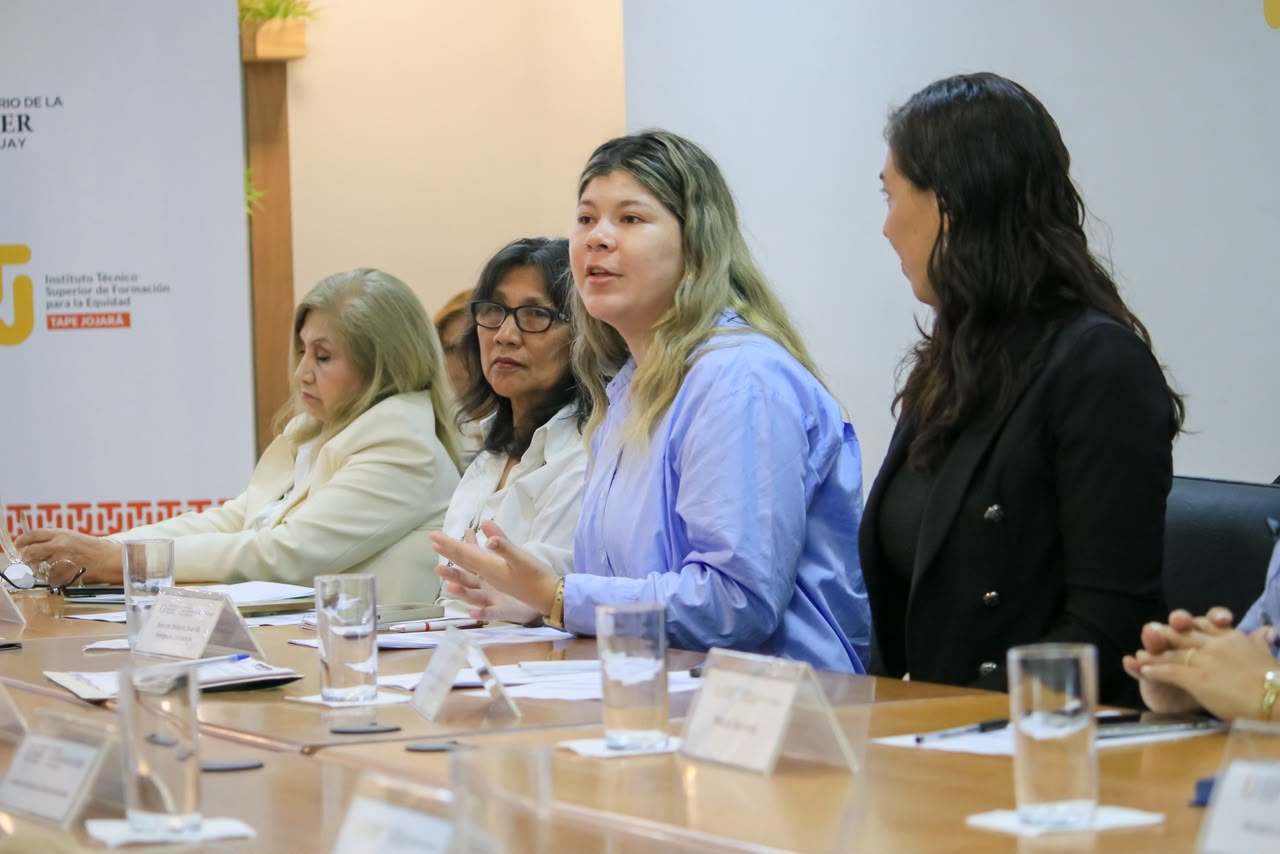
This knowledge, built patiently and in dialogue with the women affected, is what we took to Geneva.
Why we keep writing these reports
Alternative reports are one of the few ways civil society has to bring people’s experiences to the spaces where the State is evaluated. They contrast the official narrative with data, name problems that often remain invisible and pave the way for institutions to respond.
Behind each one there are years of research, interviews, surveys and accompaniment. There are also alliances: with the national, regional and international networks that sustain this agenda. No organization gets to Geneva alone. We know the context is not easy. In Paraguay and around the world we are experiencing setbacks in human rights, discourses against gender equality are gaining ground and the space for civil society is shrinking. The Committee itself warned about the impact of Law 7363/2024 on women’s organizations and human rights defenders, echoing our UPR report.
That is precisely why this work is more necessary than ever. A democracy in which women cannot participate without fear, online or offline, is an incomplete democracy. At TEDIC we will keep researching, generating evidence and building alliances so that the internet is a space where everyone can exercise their rights.
We thank our friends at CODEHUPY for supporting our report and Sonia von Lepel for bringing our voice to Geneva.
 Not with my face: The Paraguayan State deploys facial recognition without transparency or oversight
 Defending those who defend us