


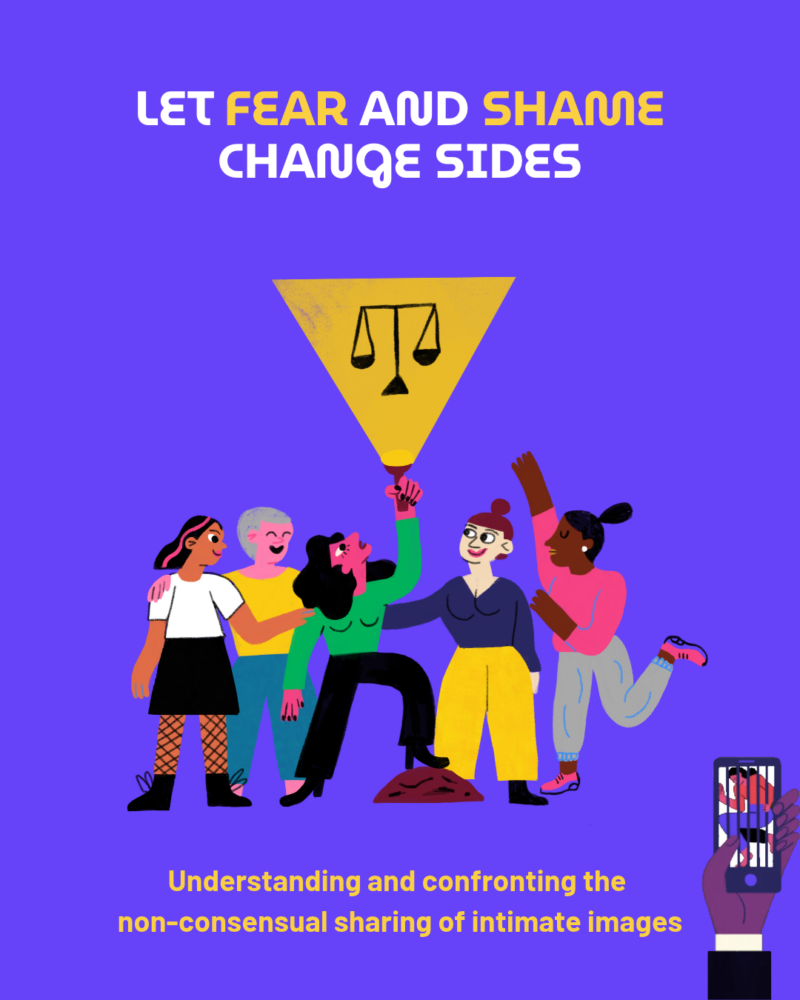
Understanding and confronting the non-consensual sharing of intimate images
On the Internet, we express our ideas, build relationships, and explore our sexuality. But violence that exists outside digital spaces also finds new ways to take place online. The non-consensual sharing of intimate images is one example. Today, artificial intelligence tools also make it possible to create sexual images that never existed or manipulate real photographs, expanding the ways violence can be inflicted even on people who have never shared intimate content.
Recent reports of incidents at the National University of Asunción (UNA) have brought this issue back into public debate. Students were exposed on websites and in groups where intimate photographs were shared, sexual content about them was requested, and sexual images created with artificial intelligence were circulated. This case shows how technology can be used to reproduce and amplify forms of gender-based violence that violate people’s privacy, autonomy, and dignity.
In this context, it is essential to understand that the problem lies not in the images or in the choices of the people depicted, but in the violation of consent and in the actions of those who perpetrate this violence. With that in mind, this article explores different forms of non-consensual intimate-image sharing, their implications for our rights, and some tools for recognizing and responding to these situations, without shifting responsibility onto the people affected.
Sexting is our right, with consent
Sexting, the exchange of sexual messages, photographs, videos, or other content—is part of the rights to freedom of expression and sexual and reproductive health (Sequera, 2021). From a feminist perspective, recognizing this right means defending people’s autonomy to make decisions about their bodies and desires, and to choose how they experience and express their sexuality, including in digital spaces. Sharing an intimate image can be an expression of that freedom and should not become a reason for shame, judgment, or punishment.
But talking about sexual freedom also means talking about consent. As Yolinliztli Pérez Hernández (2016) argues, consent cannot be understood simply as an individual decision, separate from power dynamics and gender inequalities. Historically, these inequalities have placed the responsibility on women to set boundaries and avoid violence, rather than questioning the actions of those who violate those boundaries. From this perspective, consent must be understood as an expression of autonomy: each person’s choices and limits must be respected, and one kind of permission must never be treated as permission for something else.
This does not mean ignoring the fact that sending an intimate image involves some risk. Once a photograph leaves our device, we lose some control over what another person might do with it. It is important to take precautions and choose carefully whom we share it with, but no precaution can guarantee that the image will never be saved, copied, shared, or manipulated.
Recognizing that risk, however, does not mean blaming the person depicted.
For a long time, when an intimate photograph was shared without consent, the conversation focused on questions such as: “Why did she send it?”, “Why did she trust that person?” or “Why didn’t she protect herself?” Shame fell on the person who had expressed their sexuality, while the person who had betrayed that trust was often left out of the discussion.
In the words of Gisèle Pelicot, we need “shame to change sides.”
Sending an intimate image does not mean giving someone permission to share it. Consenting to let someone see a photograph does not mean consenting to let them save it, post it, send it to others, or use it to create a new image. Trust is not permanent authorization over our bodies.
That is why this article uses the term “non-consensual sharing of intimate images” rather than expressions such as “revenge porn.” Sequera (2021) explains that this term can be problematic because it turns an intimate expression of sexuality into “pornography,” reduces an act of sexual violence to a mere dispute between former partners, and can reinforce stereotypes that divert attention from the central issue: the violation of the affected person’s autonomy.
The problem is not that someone chose to live their sexuality fully. The problem is that another person chose to violate their consent and use that intimate expression against them.
New ways to violate our privacy
Generative artificial intelligence adds a new dimension to this problem.
Deepfakes are audiovisual content that has been manipulated or generated using artificial-intelligence techniques to make it look as though someone appears in a situation they were never actually in. In the case of intimate images, this might mean altering an existing photograph, generating a nude body from a reference image, or combining someone’s face with another person’s body.
The image may be fake, but the harm it causes is not.
This also means we need to think about technology-facilitated gender-based violence (TFGBV) as going beyond the sharing of a photograph that was originally intimate. Someone may never have created or shared a sexual image and still become the target of an artificially created sexualized depiction.
Technology did not invent this form of violence, but it does make new ways of creating, amplifying, and distributing it easier.
What can we do if an image is shared without our consent?
If an intimate image is shared without our consent, there are different ways to respond. Legal options depend on the country, the context, and the circumstances of each case. People who want to pursue a formal process may wish to contact the relevant authorities and seek legal advice.
If, instead, our immediate goal is to try to limit an image’s circulation, there are tools that can complement other responses. These platforms do not replace legal proceedings or guarantee that an image will disappear completely from the Internet, but they may help prevent or limit its circulation on certain platforms.
StopNCII: for intimate images of adults
StopNCII is a tool developed by the nonprofit organization SWGfL to help adults prevent the circulation of intimate images without their consent.
It works by creating a digital fingerprint, or hash, of the image directly on the person’s device. The image is not uploaded to StopNCII. Instead, the system generates a mathematical representation that participating platforms can use to identify matches and take action according to their own policies.
One important update for the current context is that StopNCII also supports synthetic intimate images—that is, images created using artificial intelligence.
The tool does not automatically report the person who shared the content to the police, nor does it replace other protective measures. Its purpose is to help limit the material’s circulation on platforms that participate in the system.
Take It Down: if the image was taken before the person turned 18
For sexually explicit images or videos of someone under 18, there is Take It Down, a free service provided by the National Center for Missing & Exploited Children (NCMEC).
Like StopNCII, it works using hashes. The image stays on the person’s device and is not sent to the service. Only its digital fingerprint is generated and shared with participating platforms, which can use it to detect matches in their public or unencrypted spaces.
These tools can be useful for taking action quickly, but we should not forget that responsibility for the violence lies with the person who perpetrates it. Using a protective tool does not mean the person affected has to “repair” the harm or damage someone else caused.
Some ways to reduce risks
Talking about prevention should not turn into a list of rules about how we should take intimate photographs or what we can do with our bodies. There is no “right” way to take an intimate photograph that guarantees it will never be shared.
Even so, some practices may help reduce our exposure or give us a little more control over what we share. They are not guarantees, and they should never be used to blame someone when their trust has been violated.
Some options include:
- Avoid showing your face, when possible.
- Be mindful of identifying features such as tattoos, moles, scars, or other distinctive marks.
- Pay attention to the background of the photograph, since a room, an address, a uniform, or certain objects may reveal your identity or location.
- Experiment with angles and framing to decide what you want to show and what you would rather keep out of the image.
- Consider using a different watermark for each person you share the image with. This can help identify who leaked it.
- Use end-to-end encrypted communication channels to reduce the chances of third parties intercepting the content while it is being sent.
- Check where your images are stored and which devices, accounts, or people have access to them; for example, if an image is in your personal cloud storage, make sure no one else can access that account.
But even with all these precautions, none of us can completely control what another person chooses to do with an image. That is why individual precautions should never be the only response. We also need platforms that respond quickly and effectively, institutions that can handle these cases without re-victimizing people, adequate legal frameworks, and a culture that stops blaming those who experience this kind of violence.
Let technology advance, not violence
Technology changes quickly. We were already talking about intimate images shared without consent; now we are also concerned about sexual deepfakes. Platforms, tools, and the ways this content is created and distributed may change, but the basic principle underlying every sexual act should not: our consent matters.
Sexting is part of our sexuality, and taking precautions to protect our privacy matters too. But no precaution should shift responsibility onto the person who experiences violence for the choices made by the person who perpetrates it.
Consent matters online, too: sending an image does not mean authorizing someone to share it, and the fact that an image was created or altered using artificial intelligence does not erase the harm it can cause. Our intimate lives can be part of our digital lives, but they should never become a tool for harming us.
 The Synthetic Nothing: The collapse of the real in the face of the artificial