



It is becoming increasingly common for facial recognition technologies to be presented as a solution to strengthen security in public spaces. However, behind that promise there are fundamental questions: what happens to our biometric data, who stores it and how it is used, and what mechanisms exist to protect it?
Con Mi Cara No is a campaign driven by TEDIC to inform and raise awareness about the use of facial recognition cameras by the State. The initiative was launched in 2024 following the approval of the Law 7269/2024 on the Prevention, Control, and Eradication of Violence in Sport, which enables the use of these cameras at entry points to football stadiums in Paraguay.
The approval of this Law was carried out in record time, even though a company had already been awarded to purchase these devices. In October 2023, months before the law was promulgated, the company ITTI signed an agreement with the National Secretariat of Sports (SND) for an amount of 1,733,000 USD, as revealed by requests for access to public information submitted by journalists Leonardo Gómez and Josué Congo.
In this new edition of the campaign, the context has also changed. Since November 2025, Paraguay has a Personal Data Protection Law, although its implementation is not expected until late 2027. While facial recognition cameras have not yet been installed in football stadiums, the events that occurred after the Superclásico of April 19 this year led authorities to announce new “security” measures, including the implementation of these technologies to control access to matches.
In this context, and in coincidence with the FIFA World Cup 2026, from TEDIC we relaunch the campaign to share information and resources that will allow citizens to understand their rights and reflect on the risks of using biometric data at large events. Because security should not mean giving up privacy or other fundamental rights.
New evidence on biometric surveillance in Paraguay
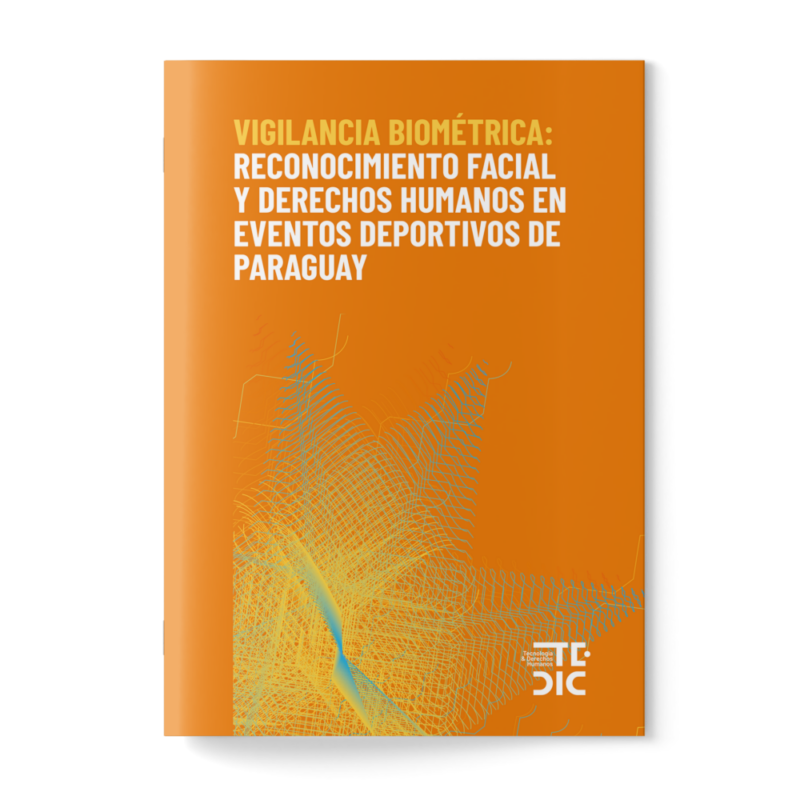
Based on the findings of the research Con Mi Cara No, we present new material developed by Antonia Bogado Rodas. “Biometric surveillance: facial recognition and human rights in Paraguay’s sporting events” delves into the use of these technologies, their growing expansion internationally, and the progress recorded in Paraguay regarding the implementation of facial recognition systems.
Through a review of the current legal framework and requests for access to public information submitted to the state institutions involved, the research analyzes how the absence of clear protocols and adequate control mechanisms can affect fundamental rights such as privacy, protection of personal data, freedom of expression, equality, and the presumption of innocence.
The study also explains how facial recognition systems work and what sets them apart from traditional video surveillance (CCTV) cameras. While the latter are limited to recording images, facial recognition systems identify and process biometric data in an automated way, enabling new forms of large-scale monitoring and mass identification in real time.
Likewise, the research analyzes experiences from countries such as the United Kingdom, Mexico, Uruguay, and Brazil, where implementing these technologies in sporting events has revealed challenges related to identification errors, indiscriminate surveillance, lack of transparency, and the absence of effective oversight.
With this publication, we aim to provide evidence to strengthen the public debate about the limits and risks of facial recognition, promoting an informed discussion about the need to implement security measures that respect citizens’ fundamental rights and do not condition access to recreational spaces on the processing of sensitive biometric data.
A practical resource to understand what’s at stake
As part of the strategy to make this conversation more accessible and dynamic, TEDIC updated and reprinted the campaign fanzine Con mi cara no. This material, originally developed during the project’s first edition, was reviewed by the team to incorporate the most recent changes in the regulatory framework related to the protection of rights.
Among the main updates is the approval of the Personal Data Protection Law. Although effective implementation is expected for late 2027, its promulgation changes the debate landscape regarding biometric surveillance technologies. The existence of this legal framework recognizes the need to establish guarantees for the protection of personal data and reinforces the responsibilities of the State and of the companies tasked with implementing and administering these systems in relation to the processing, storage, and use of the biometric data they collect.
With this update, the fanzine continues to be an outreach tool that brings clear and accessible information to citizens, strengthening the public debate about the risks of biometric surveillance and the importance of protecting our fundamental rights.
The long road to transparency: The case of facial recognition in Paraguay
The battle for the right to know which technologies the State uses to watch us has been extensive and persistent. This process began between 2018 and 2019, when the Ministry of the Interior and the National Police installed cameras with facial recognition technology in Asunción, integrated into the 911 System. With the rollout of this mass surveillance tool, Maricarmen Sequera, TEDIC’s Executive Director, filed on April 8, 2019 a request for public information requiring usage protocols, human rights impact assessments, and details about the processing of personal data.
The State’s initial response set the tone of the conflict: it denied the information, citing reasons of “national security.” This response, considered insufficient and evasive, initiated a strategic litigation stage that has continued for years. From our role as a human rights advocacy organization, we maintain that the national security argument cannot be a blank check for uncontrolled technological spying without adequate judicial oversight or public transparency.
In the face of this refusal, we challenged the secrecy of the information in Paraguayan courts. However, after a process that lasted across different stages for 6 years, the local justice system ultimately rejected our request for a constitutional protection remedy, thereby confirming the denial of the information requested. It was precisely this rejection that closed the door to an internal solution and forced us to escalate the case to seek justice beyond our borders.
In June of this year, together with the EFF and CEJIL we filed a petition with the Inter-American Commission on Human Rights (IACHR). With this action, we sought recognition of the violation of the right of access to public information.
The petition to the IACHR aims not only to achieve justice for this specific case, but also to establish a regional precedent. The organizations request that the State be required to adopt mechanisms for active transparency and to conduct mandatory impact assessments before acquiring or implementing any surveillance technology involving artificial intelligence or biometric data.
This process underscores that mass surveillance without accountability creates legal insecurity and puts democracy at risk. The struggle continues to ensure that technological progress does not translate into an irreversible erosion of our fundamental rights.
The debate reached Ciudad del Este
As part of the outreach strategy to communities directly affected by the implementation of facial recognition systems in stadiums, TEDIC organized an open discussion event in Ciudad del Este on biometric surveillance, facial recognition, and digital rights in the football context.
The event was the result of a prior coordination process with local actors, which included meetings and consultations with supporters, researchers, organizations, and community leaders, to better understand the local dynamics and identify the most appropriate methodology to create a space for dialogue. This work made it possible to build an activity tailored to the local context and foster a horizontal conversation among people with different backgrounds and interests.
During the exchange, questions arose about transparency in implementing these systems, protection of personal data, the risks of errors in facial recognition systems, and the lack of clear mechanisms for oversight and accountability. The conversation also helped introduce concepts related to digital rights to people, in many cases, who had not previously engaged with these debates.
The event also gained coverage in local media, which expanded the reach of the discussions beyond the event space and placed the issue on Ciudad del Este’s public agenda. This coverage contributed to strengthening the visibility of the campaign #ConMiCaraNo and created new opportunities to discuss the impacts of biometric surveillance in citizens’ everyday lives.


Action in Asunción: dialoguing with those who will be on the front lines
Asunción and the Central Department play a central role in the debate on facial recognition in Paraguay. In this territory, the stadiums with the highest turnout in the country are concentrated, and where the implementation of these technologies is expected to begin for controlling access to sporting events. At the same time, it is a space where organized fan groups have historically coexisted with differentiated control and surveillance measures.
As part of the campaign, from TEDIC we promoted a process of outreach with representatives of organized supporters to create a space for exchange about the implementation of facial recognition and its possible implications for the rights of people who attend matches. Although there was initial willingness to participate, the workshop ultimately could not be carried out due to internal issues within the group with which we were coordinating.
Beyond the fact that the activity was not ultimately carried out, the process made it possible to identify some challenges for future advocacy actions. As explained by Paulo González, a sociologist who coordinates and works with these groups, the people who make up organized supporters’ groups have been living for years alongside police controls, identification procedures, and other forms of surveillance in stadiums. In that context, facial recognition is not always perceived as a new threat, but rather as a continuation of practices against which these groups constantly deploy strategies to deal with institutional control exercised by actors such as the Police and the Public Prosecutor’s Office.
At the same time, taking advantage of the atmosphere created by the FIFA World Cup and the meeting spaces that formed in downtown Asunción to keep watching the matches, we went out to talk with fans and soccer supporters about the implementation of facial recognition in Paraguayan stadiums. In a context in which the National Police and the Ministry of the Interior are moving forward with preparations to roll out these technologies ahead of the restart of the Clausura tournament, we distributed fanzines, exchanged thoughts on the issue, and recorded some of the main reflections to share later on our social networks.
The experience in Asunción reaffirmed the importance of continuing to create spaces for dialogue with different actors connected to football and of bringing the debate on biometric surveillance to the places where these technologies will begin to form part of the everyday experience of thousands of people. Listening to the perceptions of those who attend stadiums and understanding how surveillance and stigmatization trajectories influence how these measures are received will make it possible to strengthen future advocacy strategies and promote an informed public debate about the limits and safeguards that must accompany any security policy based on the processing of biometric data.
The conversation was also on social media
As part of the campaign, TEDIC developed a social media communications strategy to inform and sensitize the public about the risks associated with the use of facial recognition technologies and biometric surveillance. Through various materials, the campaign explained how facial recognition cameras work, addressed the use of these technologies during the World Cup, and encouraged a reflection on their implications for privacy and human rights.
As part of these outreach efforts, Maricarmen Sequera, TEDIC’s executive director took part in the program Tobogán TV, where she discussed the expansion of mass surveillance, the use of biometric technologies in Paraguay, and the risks these pose for fundamental rights such as privacy, the protection of personal data, and people’s freedom.
In addition, the campaign went beyond the national context through an interview published in La Silla Vacía, where again our director participated, reflecting on the progress of facial recognition in Latin America, the risks these technologies represent for human rights, and the need to promote regulatory frameworks that ensure the respectful implementation of fundamental freedoms.
Art as a tool for raising awareness
We believe it is important that communication about this project not remain only in digital spaces, but can also be translated into a tangible, permanent intervention within the city. For this reason, together with Paraguayan artist Oz Montanía, we created a mural carrying the message “My data is not merchandise,” which shows a diversity of blurred faces, trying to protect this sensitive data from facial recognition technologies. The message denounces how these systems turn our biometric features into data that can be captured, processed, and used without people being aware of it. This is the second urban intervention Oz Montanía has carried out with TEDIC, continuing a collaboration made in December 2022 with a first graffiti created on Palma and 14 de Agosto streets, in downtown Asunción.
Located at a strategic point in downtown Asunción, the mural aims to spark curiosity, generate conversations, and bring the debate on biometric surveillance and personal data protection to people who pass through the area every day. Through urban art, the intervention turns public space into a setting for reflection, expanding the project’s reach and demonstrating that defending our rights can and should take place on the streets, becoming part of everyday life.

The challenge continues
The implementation of facial recognition technologies in Paraguay is still at a stage where it is possible to review how these systems are designed, regulated, and applied. Experiences from other countries show that incorporating these tools without transparency, without adequate controls, and without safeguards for the protection of human rights can generate impacts that are difficult to reverse.
From TEDIC, we will continue to monitor the implementation of these technologies, promoting advocacy actions, strategic litigation, research, and monitoring to foster an informed public debate and require that any surveillance policy respects the principles of transparency, proportionality, accountability, and the protection of personal data and fundamental rights such as privacy and freedom of expression. Paraguay still has time to build a model in which innovation and security are not developed at the expense of our fundamental rights.
 [Research] Technology-facilitated gender-based violence against women politicians in Paraguay